Explore

Irish dairy farming and the challenge of nitrogen runoff

Ireland’s rainfall powers its grass-based dairy system but raises nitrogen runoff risks. How are farmers protecting both productivity and water quality?
Explore

Irish dairy farming and the challenge of nitrogen runoff

Ireland’s rainfall powers its grass-based dairy system but raises nitrogen runoff risks. How are farmers protecting both productivity and water quality?

Ireland’s grass‑based dairy system benefits from high rainfall and fertile soils, but those same conditions increase the risk of nitrogen runoff into waterways. The Irish dairy industry is responding through more precise nutrient strategies, changes in fertilizer use, catchment‑led advisory programs and coordinated action among farmers, co‑operatives and policymakers. These efforts aim to protect water quality while preserving the productivity and economic importance of Irish dairy.

The nitrogen, climate and weather that support dairy farming in Ireland can also cause dairy nitrogen runoff, a growing strain on the country’s historically pristine waterways. This nutrient pollution can contribute to water quality degradation and the growth of algae.

Why is this happening, and how is sustainable dairy farming in Ireland helping to combat it?

How rainfall supports pasture-based dairy farming in Ireland

Ireland’s steady and substantial rainfall is key to the nation’s global dairy success, sustaining the grasses that underpin the country’s pasture-based farming systems by nourishing its 1.6 million dairy cows. Ireland’s mild climate also enables cattle to graze outdoors for much of the year, with grazed grass and grass silage making up the vast majority of annual intake.

This pasture-based dairy farming system is key to Ireland producing a large volume of nutrient-dense dairy products while also reducing greenhouse gas emissions, maintaining one of the lowest carbon footprints globally.

Getting the balance right

Carbon emissions, though, aren’t the only important sustainability metric. Nitrogen, which is often used as a fertilizer on Irish pasturelands, can also impact the environment

Sometimes, nitrogen-based fertilizers are organic, from the farm’s own livestock; sometimes they are inorganic and purchased from elsewhere. Regardless, excess nitrogen can become a problem, with variable rainfall patterns washing it away before the grass can utilize it. This nitrogen, in the form of nitrates, flushes into streams and rivers and leaches through the region’s permeable soils into groundwater.

While the water in Ireland is still widely considered to be of good quality overall, Irish dairy farmers aren’t waiting until the challenge becomes a crisis. They’re already solving it with sustainable farming practices.

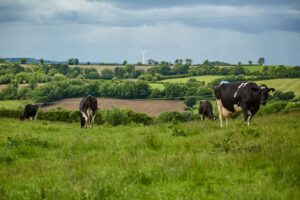
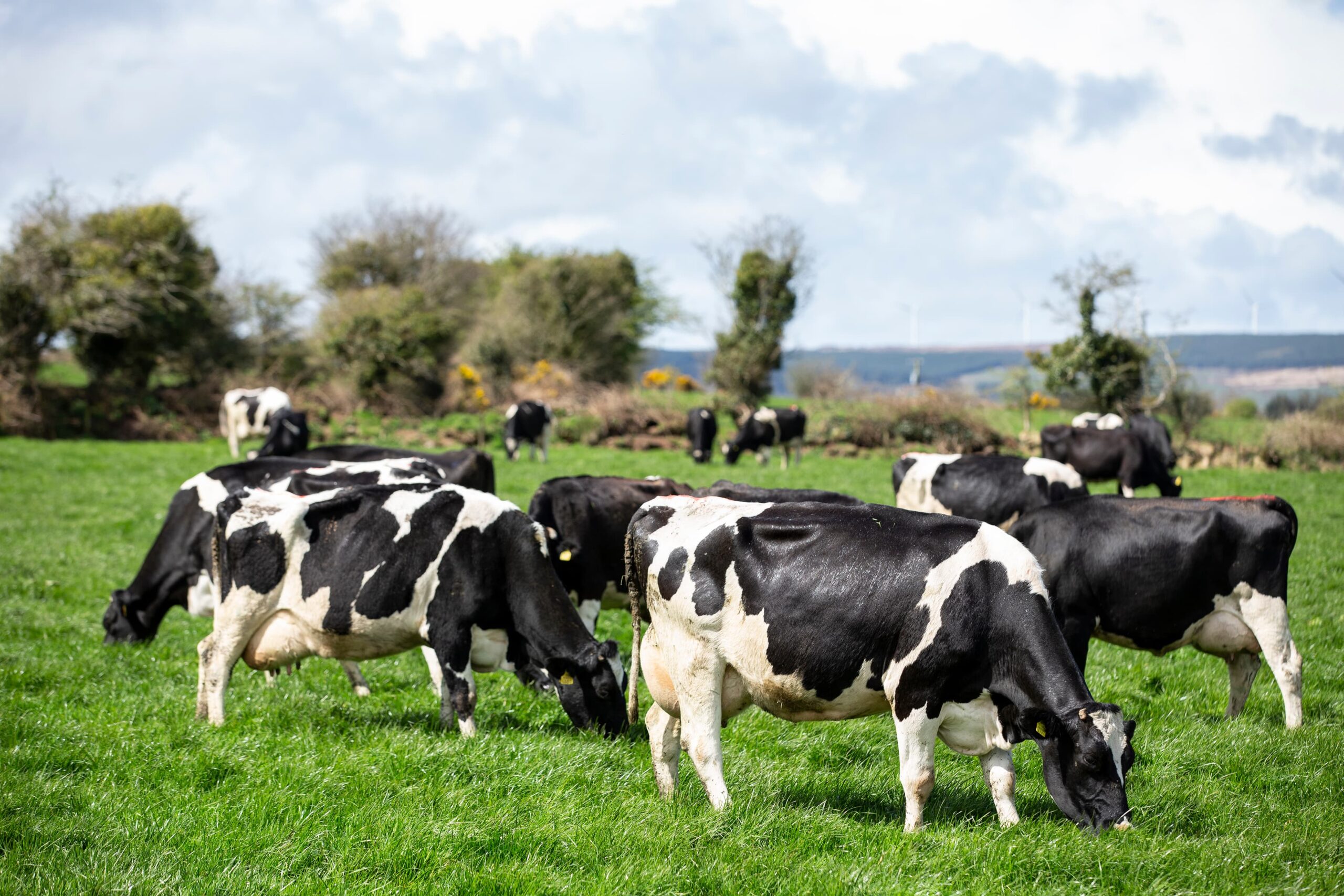
Holstein dairy cows graze on Irish pasture, where farmers are working to protect productivity while managing nitrogen runoff.
To ensure Ireland’s pastures remain productive and the land continues to thrive, dairy producers nationwide are taking active steps to reduce the environmental footprint of their operations.

Balancing productivity with protection

The nitrate levels in Irish waterways do exceed the European Union’s notably high — and strictly enforced — standards for water quality.

However, in acknowledgement of Ireland’s early and effective mitigation initiatives, the EU has granted Ireland a temporary exception from the EU Nitrates Directive. This exception, known as a derogation, allows farms that meet stricter environmental criteria to operate at higher stocking rates, provided they demonstrate robust nutrient management and water‑protection measures.

In December 2025, all 27 EU member states unanimously agreed to extend through 2028 the nitrate derogation Ireland was granted, while also introducing tighter conditions aligned with continued improvements in nutrient efficiency and water protection.

In addition to protecting Ireland’s waterways, this continuing EU derogation is protecting Ireland economically. The stakes are high: dairy farming in Ireland supplies products to more than 140 export markets, generating €7.3 billion in export revenue in 2025 alone. Without a derogation, Ireland could lose up to 200,000 dairy cows, 1.2 billion liters of milk, and €1 billion in export revenue every year.

How Irish dairy farmers are reducing nitrogen runoff

True to Ireland’s long tradition of cooperative action, dairy producers, co-ops, researchers and policymakers have been combining their efforts to make measurable progress, reinforcing the successful and sustainable dairy farming Ireland is known for.

Key actions include:

  • Low emission slurry spreading (LESS) – Around 85% of Irish dairy farms now use low emission slurry spreading (LESS), a technique that applies slurry closer to the soil surface rather than spraying it into the air.
  • More targeted nutrient use – Improved soil testing and better nutrient strategies allow nitrogen to be applied more carefully, at the right rate, place and time.
  • Clover integration – Reseeding grassland with clover offers substantial nutritional value for dairy cows and fixes nitrogen naturally through bacteria stored in its root nodules. Such cover crops also promote soil health, helping to reduce dependence on synthetic fertilizers.
  • Protected urea replacing CAN – Calcium ammonium nitrate (CAN), a widely used fertilizer type, is being replaced by protected urea, which is much less likely to be washed away before the plants can utilize it.
  • Targeted advisory and investment programs – Ireland-based initiatives such as and European programs like the are directing resources to higher‑risk areas, pairing expert on‑farm advice with tailored farm-level interventions.


These changes are adding up. Recent monitoring indicates early signs of stabilization and improvement in some rivers, although trends vary by catchment.

Scientific insight:

A 2026 peer‑reviewed study in the Journal of Dairy Science found that Irish dairy farms using practices such as LESS and protected urea achieved strong nitrogen use efficiency, even at higher stocking rates. These findings show that precise nutrient management can reduce nitrogen runoff while sustaining productivity in pasture‑based farming systems.

“Collaborative catchment‑based approaches are proving to be one of the most effective ways to deliver meaningful improvements in water quality. Our Farming for Water: River Slaney program shows that when farmers, advisers and scientists work together at the local level, targeted actions can deliver real impact — including a 12% reduction in nitrogen loading leaving the catchment. By focusing effort where risk is highest and supporting practical change on-farm, we can protect water quality while sustaining productive, family‑based dairy farming.”
Dr. Lisa Koep
Chief ESG officer at Tirlán, one of Ireland’s leading dairy cooperatives

The world is watching

Progress on this issue is also reinforcing Ireland’s role as a global model for the dairy industry. With , Irish dairy farmers are demonstrating how dairy producers can help feed the world abundantly in ways that are both economically and environmentally sustainable.

Go inside Ireland’s pasture-based dairy landscape, a global model for sustainable dairy farming, by watching World Without Cows Ireland: The Pasture Paradox — the latest mini-documentary in our global story.

Frequently Asked Questions (FAQ)

What causes nitrogen runoff from Irish dairy farms?

Nitrogen runoff occurs when excess nitrogen from organic manures or inorganic fertilizers used on an Irish dairy farm are washed away by rainfall before the grasses can absorb them. Ireland’s abundant rainfall and permeable soils increase this risk.

How are Irish dairy farmers reducing nitrogen runoff?

Irish dairy farmers are improving nitrogen management through low emission slurry spreading, targeted fertilizer application, increased use of clover as a cover crop, and replacing traditional fertilizers with protected urea. These measures reduce Irish dairy environmental impact by keeping nutrients in the soil, ready to be utilized by the plants.

Can Irish dairy farmers balance productivity with water quality?

Reducing productivity would reduce nutrient runoff, but it would harm the Irish economy and prevent protein-rich Irish dairy from nourishing the world. Coordinated action between farmers, co‑operatives, advisers and policymakers is enabling dairy farming in Ireland to thrive even under increasingly strict environmental standards.

Explore more

Help us start the conversation.

As climate change intensifies and the world’s population continues to grow, the pressure on our global food production system mounts. You can play an active role in shaping a more sustainable planet for future generations. Fill out the form below to learn more about how you can partner with us.